
Pediatric oxygen & respiratory support
Oxygen & Respiratory Support at home
Breathing problems escalate quickly in children. Skilled eyes at home catch the change early, when it is still a conversation rather than an ambulance.
What this involves
Children need respiratory support for many reasons: chronic lung disease of prematurity, neuromuscular conditions that weaken the cough, aspiration, or airways that narrow with every virus. Support ranges from a little oxygen overnight to nebulised medication, airway clearance and close monitoring.
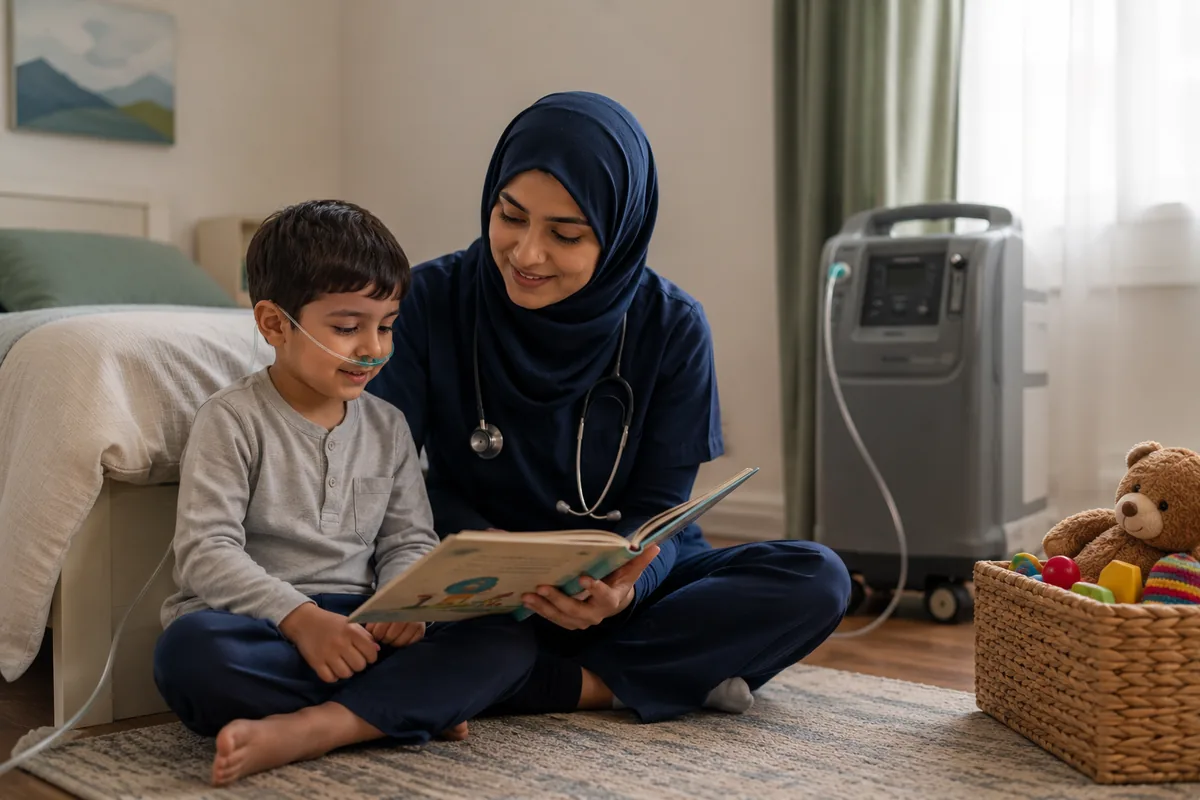
The clinical skill is in the assessment. Oxygen saturation is one number; a nurse also watches work of breathing, colour, chest sounds, alertness and feeding, because children compensate well until, suddenly, they do not.
On every shift
What our nurses do
Written into the care plan, done the same way every shift, and documented.
- Oxygen therapy delivered and titrated exactly as prescribed
- Nebulised and inhaled medication administered on schedule
- Airway clearance techniques as prescribed: cough assist, chest physiotherapy, suctioning
- Pulse oximetry monitoring, with attention to trends and not just single readings
- Full respiratory assessment each shift, documented so changes are visible over time
- Equipment checks: concentrator, cylinders, tubing, humidification and backup supply
Winter is a different season for these families
For a child with fragile lungs, an ordinary cold is not ordinary. Respiratory season is when home nursing earns its place: daily assessment, earlier escalation, and a clinician who already knows your child’s baseline.
We document that baseline deliberately, so “she sounds different today” becomes something specific enough for a physician to act on.
Questions
Questions families ask about oxygen & respiratory support
What oxygen saturation should we worry about?
The target range is specific to your child and set by their physician. A number that is fine for one child is concerning for another. Ask for it in writing, along with what to do if readings sit below it. Our nurses work to that written range.
Is home oxygen safe with other children in the house?
It is used safely in family homes every day, with sensible precautions: no smoking or open flame nearby, cylinders secured, tubing routed so nobody trips. Our nurses check the setup and talk it through with everyone in the household.
Can nursing help avoid hospital admissions?
Early recognition helps, and that is the point of daily skilled assessment. We will not promise outcome numbers, as no honest agency can, but noticing a change on day one rather than day three gives your child’s physician more options.
Also available
Other services
Tracheostomy Care
Safe, expert trach management by nurses trained and competency-verified in pediatric airway care.
Ventilator Care
Skilled care for children on mechanical ventilation, with continuous monitoring and rapid response.
G-Tube & Enteral Feeding
Nutritional support and feeding tube care, built around your child’s schedule and your family’s routines.
Seizure Management
Monitoring, accurate medication administration, and calm, practised response when seizures happen.
Medication Management
Timely, accurate administration and documentation of complex medication regimens.
Complex Nursing
Coordinated, whole-child care for children whose needs cross several conditions at once.
Content last reviewed . This page is general information, not medical advice — please talk to your child’s physician about their care.
Talk to a nurse, not a call centre
Tell us what your child needs and we will tell you honestly whether we can help.